by The Editors on May 14, 2009
 Billabong’s stock went into a trading halt soon after the market opened yesterday, according to Australia’s the Age and now analysts are stuck trying to figure out exactly what that means.
You’ve got two choices,” one analyst said. “A capital raising for who-knows-why, or a profit downgrade. Or if you want to be really, really wild, how about an upgrade. There’s enough anecdotal evidence to say it’s not on the upside.” . . .A second analyst agreed, saying: “Most of the market’s expecting their profit to come in below their guidance, but not dramatically so.”
We’re not even going to guess on this one. We’ll all know soon enough. But it doesn’t sound good.
[Link: The Age]
by The Editors on May 13, 2009
 American Insurance Group, the company that owns Vermont’s Stowe Mountain Resort announced today that they are putting the resort up for sale according to a story in the Burlington Free Press.
“We’re actually putting Stowe up for sale. So it’s official now,” Peter Tulupman, spokesman for AIG, told The Burlington Free Press this morning. . . Tulupman declined to comment on how much American International Group Inc. — which is mostly owned by the U.S. government after a sequence of federal bailouts in the wake of Wall Street’s collapse last fall— is seeking for the iconic resort which includes the lavish Stowe Mountain Lodge and the mountain’s operations.
As we learned in Hal Clifford’s book Downhill Slide resorts are all about the real estate that surround them and it is a buyers market right now. Anyone?
[Link: Burlington Free Press via Yobeat]
by The Editors on May 12, 2009
As creditors rifle through former Billabong CEO Matthew Perrin’s estate his wife Nicole Perrin is now claiming that she didn’t sign several documents and that they must have been forged, according to a story in the Sydney Morning Herald.
Mrs Perrin made the claim in a restraining order she has sought to stop the bank repossessing her $15 million Surfers Paradise mansion. The bank is trying to recoup $13.5 million Mr Perrin borrowed against the family home and a Mermaid Beach apartment last year. . . Lawyers for Mrs Perrin argue that as the signatures on the loan documents are a “counterfeit forgery”, the mortgages and guarantees are “mere nullities having no legal force or effect”. It is alleged the signatures of Mr Perrin’s brother Fraser Perrin, a Gold Coast solicitor who “witnessed” Mrs Perrin’s signatures, are also fake.
Nicole reportedly bought the house with money from her personal sales of 13 million shares of Billabong stock and never signed it over to anyone. This might buy her at least a couple more weeks in the house, huh?
[Link: Sydney Morning Herald]
by The Editors on May 11, 2009
 Get all the details from Volcom’s recent SEC filling right here. We haven’t read the entire document, but this caught our eye:
Sales to Pacific Sunwear increased 21.8%, or $1.5 million, for the three months ended March 31, 2009 compared to the three months ended March 31, 2008. We currently expect a decrease in 2009 revenue from Pacific Sunwear compared to 2008. It is unclear where our sales to Pacific Sunwear will trend in the longer term.
As PacSun sales fall, Volcom gets further into bed with the mall. Maybe that’s because VeeCo is the only brand that is checking. Read the rest for yerself.
[Link: MarketWatch]
by The Editors on May 7, 2009
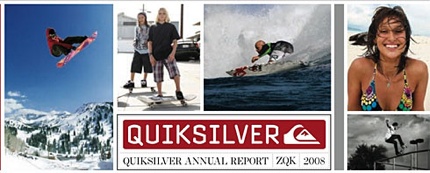
When you’re $1 billion dollars in debt and you have a huge payment to European lenders coming due on June 30, 2009 you have to cut back: even on the annual report, according to a story in USA Today.
Every spring, Quiksilver’s (ZQK) investors could look forward to having a thick annual report land in their mailboxes, filled with colorful photos of tanned bodies and monster waves. Not this year. . . As part of cost cutting not only at the Southern California surf wear company but at many companies, the traditional printed annual report to shareholders is slimming down if not disappearing completely.
Every little bit counts. Wonder if they’ve ratcheted back on Fed Ex, too?
[Link: USA Today]
by The Editors on May 6, 2009
 The action sports fashion retail story continues to be grim, but not as grim as analysts had predicted at Zumiez. Today the mall store reported that April sales were only down 13.8 percent versus last year.
Analysts, on average, had expected the same-store sales to fall 14.1%, according to Thomson Reuters. Total net sales for the four-week period ended May 2 decreased 1.7% to $23.8 million, said the specialty apparel retailer.
Not too bad, really.
[Link: Marketwatch.com]
by The Editors on May 5, 2009
 This comes as no surprise, but it appears that the board of directors at West 49 has rejected Adrenalina’s offer to purchase the company.
West 49 Inc.’s board of directors has unanimously rejected the unsolicited proposal as it does not believe that pursuing Adrenalina’s proposal is in the best interests of West 49 Inc. or its shareholders. The board of directors noted that Adrenalina is an unlisted U.S. public company that has recently indicated that it does not have the financial resources to file its legally required annual report, that has an unproven business model and operates a very small number of highly expensive retail stores in the U.S., and that has recently made a similar and unsuccessful unsolicited attempt to acquire Pacific Sunwear of California, Inc.
Owwwhh, burn.
[Link: Newswire.ca]
by The Editors on May 4, 2009
 ESPN has decided that what they need to sell X Games sponsorship is someone from their NBA sales team, according to a story in the Sports Business Journal.
ESPN has reorganized its X Games sales staff, putting ESPN’s NBA sales executive Michele Krumper in charge of X Games sponsorships and bringing X Games general manager Chris Stiepock to more sales meetings. . . . The move is part of an effort to bolster X Games sponsorship sales in an economic period when finding corporate partners willing to align with sports properties has become more challenging.
More challenging is such a nice way to say it.
[Link: Sports Business Journal]
by The Editors on May 4, 2009
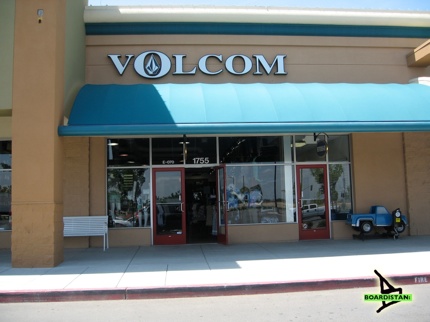
Reno’s monsterous shopping zone The Legends at Sparks Marina is set to open on June 18, 2009 and aside from a Best Buy, Target, and Banana Republic, the mall will also include a Volcom outlet store.
Oddly, neither this new one in Reno, nor the outlet in Preferred Outlets of Tulare, California are listed on Volcom site. Strange, isn’t it?
[Link: About.com]
by The Editors on May 4, 2009
 Not content with wading through the press with buyout talks and board member suggestions for Pac Sun Adrenalina CEO Ilia Lekach now wants to buy Canada’s West 49 for 55 cents (Canadian) a share, according to a story on Google news.
“The business synergies from joining West 49 Inc.’s substantial store footprint with Adrenalina’s high-growth lifestyle retailing concept are compelling – especially in this challenging economic environment,” said Ilia Lekach, chairman and CEO of Miami-based Adrenalina in a release.
We can say that $35 million Canadian seems a little more realistic for the four-store chain than the $293 million they wanted to pay for Pac Sun Then again, who doesn’t Lekach believe Adrenalina has “synergies” with.
[Link: Google]
 Billabong’s stock went into a trading halt soon after the market opened yesterday, according to Australia’s the Age and now analysts are stuck trying to figure out exactly what that means.