
Here is the sometimes weekly list of stories that showed up in our feed. For a quick scroll, please follow the jump.
{ Comments on this entry are closed }
Here is the sometimes weekly list of stories that showed up in our feed. For a quick scroll, please follow the jump.
{ Comments on this entry are closed }
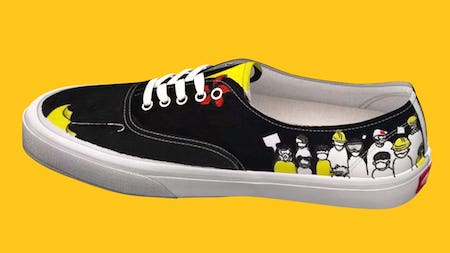
The downside of holding an open design competition is that someday, someone is going to design something that someone else has a problem with. Well, Vans experienced that this week, according to a story on CNN. The someone is “a Canada-based user named Naomiso” and the someone else with a problem just might be the People’s Republic of China. Vans reportedly pulled the design (along with others) from their Custom Culture design competition on Saturday, October 5, 2019 saying in a facebook post:
“As a brand that is open to everyone, we have never taken a political position and therefore review designs to ensure they are in line with our company’s long-held values of respect and tolerance, as well as with our clearly communicated guidelines for this competition,” the statement said, without referring specifically to the protest-themed design.
The shoe, shown above, features “a red bauhinia, the flower on Hong Kong’s flag, and one of the yellow umbrellas synonymous with the city’s 2014 pro-democracy protests.” The designer was told the submission was pulled for the following reason:
“Not allowed: Trademarked or copyrighted material, business or brand logos, images of celebrities, professional team logos or mascots, nudity, images of weapons/violence, images referencing drugs, alcohol or smoking, offensive contest, obscenity or hate.”
Obviously, there are a few people upset by the shoe’s removal, and now a #boycottvans movement has apparently started. According to CNN, one Hong Kong shoe retailer has closed three of their stores because of “the controversy created by the contest.” Rough going for a contest about creativity and expression. For the rest of the story, please click the link.
[Link: CNN]
{ Comments on this entry are closed }
 In his October letter to what’s left of the Snowsports Industries of America, President Nick Sargent announced that the SIA is now opening membership to “include retailers, reps and resorts,” because, well, what else can the organization do to increase revenue?
With our mission to “help the industry thrive, “ we believe that it is imperative to truly speak to the entire industry so that together, we can find common areas of alignment within our key initiatives: climate advocacy, participation, research, education, and B-to-B events to drive the entire industry forward. We are excited about this new, more collaborative direction for SIA.
Hopefully, there are still winter sports retailers and reps left who will ante up. What do they get exactly for this membership? You’ll have to read the rest of the letter to figure that out ’cause we have no idea.
{ Comments on this entry are closed }
 It was only a matter of time before old media sports titan Sports Illustrated felt the bite of digital publishing, and that time was yesterday according to a story in The New York Post.
Zombie brand collector Jamie Salter’s Authentic Brands Group, which purchased the venerable Sports Illustrated brand in May 2019, ended up cutting 40 of the magazine’s 150 staff members on Thursday October 3, 2019 through their contract publisher Maven.
As news of the impending cuts circulated, about three-quarters of the staff signed a petition calling on SI’s new owner, Authentic Brands, to rescind its 10-year licensing deal with digital publisher The Maven, headed by Jim Heckman. . . “The Maven wants to replace top journalists in the industry with a network of Maven freelancers and bloggers, while reducing or eliminating departments that have ensured that the stories we publish and produce meet the highest standards,” read the petition, which was first reported by NPR.
Why is this interesting to us? Well, Mr. Salter was involved with Kemper Snowboards, co-founded Ride Snowboards and, in addition to Sports Illustrated, currently owns Airwalk, Vision Street Wear, and most of Volcom. And if things keep going in this direction he will eventually own everything. Yes, he’s seems to have a knack for reanimating profits from dead brands.
[Link: The New York Post]
{ Comments on this entry are closed }
 Rip Curl, today (September 30, 2019) announced that they have sold the company to New Zealand camping gear company Kathmandu for a whopping $350 million Australian dollars, according to a story in the Daily Mail.
Kathmandu, headquartered in Christchurch, is buying 100 per cent of Rip Curl for $350million, it told the Australian Securities Exchange on Tuesday morning. . . The acquisition will create a $1billion outdoor recreation company.
Kathmandu? If I ever get out of here, that’s what I’m gonna do. Oh, sorry. Ah, we’re right happy for the Warbricks and Singers, but it is sad to see the last independent surf fashion rat launch a massive swan dive off the sinking surf industry ship. We are, however, looking forward to Rip Curl canteens and camp chairs for lounging on the slopes of Mt. Cook. For the rest of the story, please click the link.
[Link: Daily Mail]
{ Comments on this entry are closed }
 The commercial entity that owns half the action sports clothing industry (Boardriders and their brands Quiksilver, Billabong, ROXY, DC Shoes, RVCA, Element “and others”) announced yesterday that they are “launching a multi-year growth agenda and repositioning. . . key executives.”
A quick read-through of the release resulted in exactly one data point that even remotely interested us and it is this: Kevin Meehan is leaving RVCA. Of course, the way they said it is epic: “Kevin Meehan has decided to take the opportunity provided by this transition to pursue new opportunities.” Congrats, Mr. Meehan.
The rest of the news can best be summed up by this quote from the boss.
“The long-term strategy for Boardriders has always been to build a solid foundation by integrating the Billabong acquisition onto a common back-end platform, to continually improve our operations through more disciplined business practices, and to achieve significant synergies that could then be invested back into the brands,” said Boardriders CEO David Tanner. “After a decade of headwinds and restructuring, Boardriders now has that strong foundation and is ready and able to invest strategically at scale in our brands, our people, and these targeted growth initiatives.”
Right. You know all that bad stuff that’s been happening for the LAST 10 YEARS? That’s all behind them now, and everything is looking up, up, up. If that doesn’t make you smile, follow the jump for the rest of the release.
{ Comments on this entry are closed }
 After losing money each year for most of the last decade, the investors behind the Carlsbad, California based Spy Optic have finally secured an exit in Bollé Brands, according to a press release from the company. The terms of the deal were not announced.
“We are excited to have acquired such an amazing brand. SPY Optic has its own unique and irreverent identity with huge growth potential in North America, its home market, and internationally where SPY Optic will leverage our Bollé Brands international distribution network,” said Peter Smith, CEO of Bollé Brands. “Our dedicated approach, support, and investment will drive exciting new developments in product innovation and design which will form the basis of considerable global growth. This new acquisition establishes Bollé Brands as one of the key players in the premium performance sport and lifestyle eyewear and helmets markets.”
Bollé, which was formerly owned by Vista Outdoor (they sold the brand in September 2018), is currently owned by A&M Capital Europe, SCSp: a France-based private equity arm of the Greenwich, Connecticut based A&M Capital Partners. (Nice that someone is smart enough to find value in all this, right). For the official word form Bollé please follow the jump.
{ Comments on this entry are closed }
 Former Salomon/Bonfire and Patagonia marketer Tyler LaMotte is the new chief brand officer at Jackson Hole Resort, according to a story in the Jackson Hole News and Guide.
“It’s great to come back and be able to experience this place and get so close and be able to do all the things that we love to do,” he said. “One of the main draws and attributes was the fact that, you know, there’s only one Jackson Hole.”
For the rest of the story and a pretty detailed dive into where he’s been and how Tyler ended up in Jackson, Wyoming, click the link.
[Link: Jackson Hole News and Guide]
{ Comments on this entry are closed }
 Thanks to a new study published in the Journal of the American Medical Association it has been shown that drinking sodas (like the brands that sponsor skateboarding, snowboarding, and surfing events) is bad for your health and increases your changes of dying sooner rather than later, or as they put it there is an “association between soft drink consumption and mortality.”
In this population-based cohort study of 451, 743 individuals from 10 countries in Europe, greater consumption of total, sugar-sweetened, and artificially sweetened soft drinks was associated with a higher risk of all-cause mortality. Consumption of artificially sweetened soft drinks was positively associated with deaths from circulatory diseases, and sugar-sweetened soft drinks were associated with deaths from digestive diseases.
In other words, rather than trying to encourage people to drink more, we should encourage them to drink less. That’s the main reason why we’re not into seeing action sports brands partnering with caffeinated, carbonated, high fructose corn syrup poison peddlers. Drink water. Duh.
[Link: JAMA]
{ Comments on this entry are closed }

Tradeshows have been closing their doors for all kinds of reasons lately (consolidation, no exhibitors, etc. . . ), but Surf Expo has the best one yet: a massive hurricane named Dorian. Anyone who has weathered a hurricane party at Surf Expo in the past will wonder, “Hey, we’ve survived them before, why not this year?” And really, what’s more fun that getting drunk with all your East Coast industry friends while some poorly named storm blows your trunks off with hot rain blasting in from the Atlantic at 112 MPH? Well, sadly the State Florida no longer has a sense of humor when it comes to storms. What with the whole place predicted to be four feet underwater in 20 years, they’re just not fooling around anymore.
“We understand that Surf Expo plays an important part in connecting buyers and sellers in the Boardsports Beach & Resort industries and that many rely on our marketplace for filling their commerce needs, but travel and logistical difficulties and, more importantly, our customers’ safety is at the forefront of our minds. Given the state of affairs regarding Hurricane Dorian today, we had no choice but to cancel Surf Expo. We recognize that many of our customers will be directly impacted by Hurricane Dorian and feel their focus should be on their families, businesses and community at this time”, said Roy Turner, SVP, Surf Expo Show Director, Emerald Expositions.
So sip your Margaritas somewhere else this September and pray this wasn’t the final nail in the Surf Expo coffin. For more info click the link.
[Link: Surf Expo]
{ Comments on this entry are closed }


